Brown Ceiling Stains: What They Mean and What to Do Next
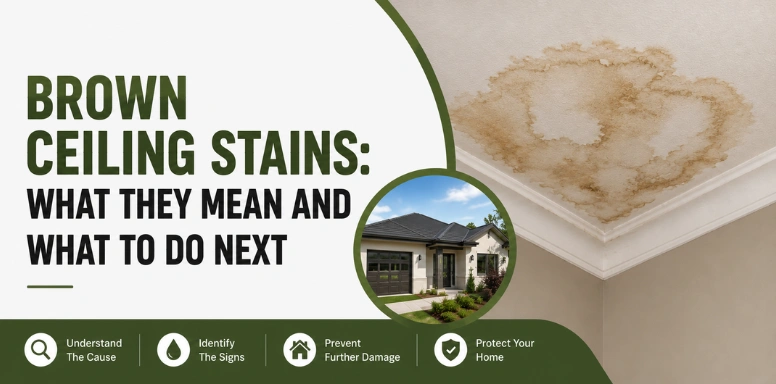
A brown mark appears on the ceiling. It is small at first, maybe the size of a coaster, slightly darker at the edges than the middle. A week later it is the size of a dinner plate and there is a smell in the room. Ceiling stains are one of the most common reasons people call us, and they are also one of the most commonly misdiagnosed problems in a house, because the obvious explanation is usually the wrong one.
The First Question: Is It Water or Is It an Animal
Most people assume a roof leak, and sometimes that is exactly what it is. The two look similar at a glance but behave differently, and you can usually tell them apart without going anywhere near the roof.
Signs of a Water Stain
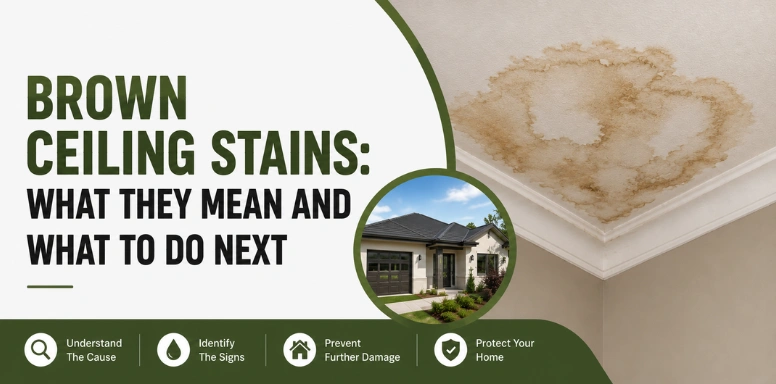
- A defined tide line, often with concentric rings where the wet edge dried at different points.
- Expands during and immediately after rain, and stops growing in dry weather.
- Smells of damp, or of nothing at all.
- A fairly even tan or grey brown colour, flat rather than glossy.
Signs of a Decomposition Stain
- Grows steadily regardless of the weather, sometimes faster on hot days.
- More yellow or rust coloured, often greasy looking rather than flat.
- Frequently has a darker centre where the fluid volume is heaviest.
- Accompanied by an odour that gets stronger as the stain gets larger.
- Fly activity nearby, particularly around the light fitting closest to the mark.
The simplest test of all: if the stain grew during a fortnight of dry weather, it is almost certainly not a leak.
What Is Actually Happening Above the Plaster
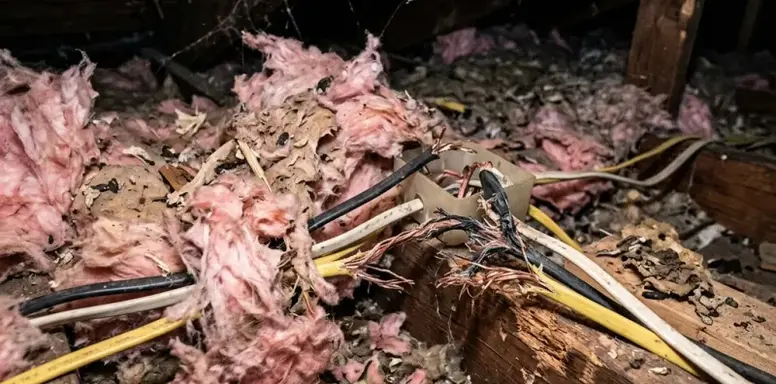
When an animal dies on top of a ceiling, the soft tissue breaks down and releases fluid. That fluid is a mix of water, fats and proteins, and it goes where gravity takes it. The sequence runs like this:
- Fluid saturates whatever insulation is directly underneath, usually glass wool batts or loose fill cellulose.
- Insulation is highly absorbent and holds that fluid rather than letting it drain, which is why the stain often appears days after the smell rather than at the same time.
- Once the batt is saturated, fluid begins wicking into the plasterboard beneath.
- Plasterboard is gypsum with a paper facing and draws liquid outward through capillary action, which is why the stain spreads sideways as well as downward and keeps growing long after you first notice it.
The greasy look comes from the fat content. This matters for what happens later, because fats do not wash out of plasterboard and will bleed back through ordinary paint.
What the Size and Location Tell You
Size Points to the Species
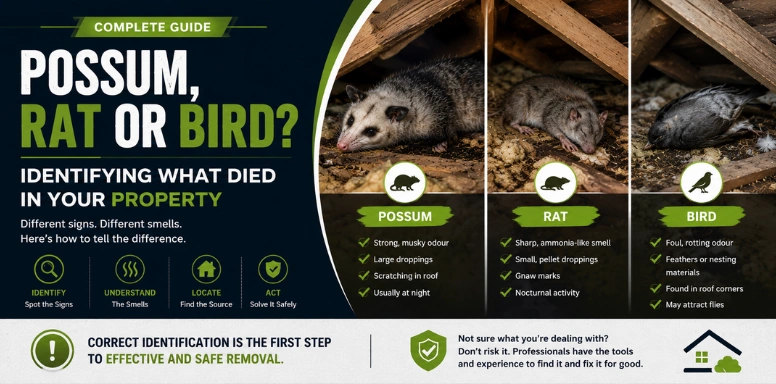
- Mouse: rarely produces a visible ceiling stain at all.
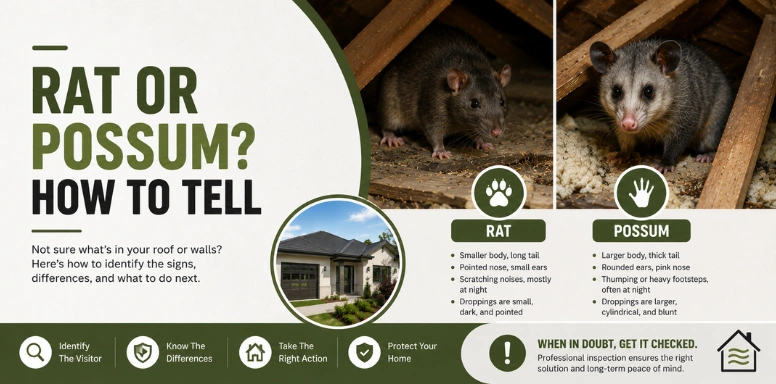
- Rat: usually modest, somewhere between a coaster and a saucer.
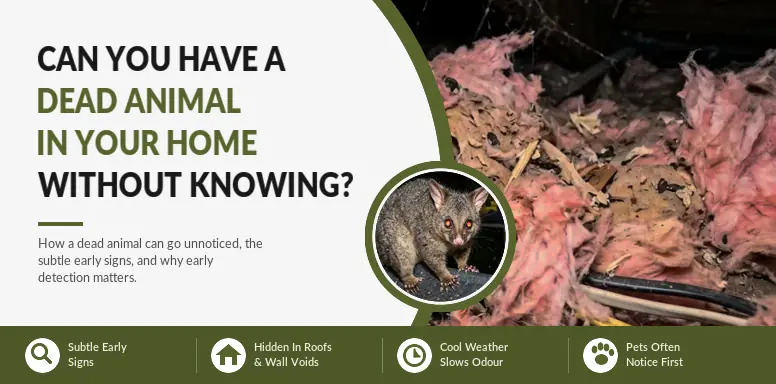
- Possum (3 to 5 kilograms): commonly a dinner plate or larger. Possums are the species behind the majority of significant ceiling stains we attend in Melbourne homes.
Location Points to the Access Difficulty
- Near the centre of a room: the animal died in open roof space, which is generally straightforward to reach through a manhole.
- Hard against a wall line: the animal is likely on the top plate of the wall frame, or has fallen into the wall cavity itself. A more involved recovery.
- Cathedral or raked ceiling: the difficult one, because there is no accessible cavity above and access has to be created deliberately.
Why Painting Over It Does Not Work
This is the single most common mistake, and we see the consequences regularly. Painting a decomposition stain achieves nothing durable for three reasons.
- The fats and oils bleed through. Water based ceiling paint has no capacity to block them, so the mark reappears within weeks, sometimes within days in warm weather. Even oil based stain blockers only work once the source material has been removed and the substrate has fully dried.
- The source is still there. Painting the underside of a ceiling does nothing about the carcass and saturated insulation sitting on top of it, which will continue producing both fluid and odour.
- The bacteria remain. The affected plasterboard and framing carry a bacterial load that needs antimicrobial treatment, not a coat of paint sealing it in.
What a Proper Job Involves
The sequence matters, and skipping steps is what causes recurrence.
- Locate the animal precisely. On a stained ceiling this is usually straightforward, because the stain marks the position within a few hundred millimetres, but confirmation with a camera before opening anything is still worthwhile.
- Remove the carcass and nesting material into sealed containment. Where a native species is involved, handling and disposal are done under the applicable wildlife requirements. Our possum removal from ceiling cavities work covers exactly this scenario, which is the most frequent cause of a large ceiling stain in a Melbourne home.
- Cut out and remove the contaminated insulation. Saturated batts cannot be cleaned, dried or turned over. They hold odour and bacteria indefinitely, and leaving them is the main reason a smell returns after a cheap job. The affected section is replaced with new material.
- Treat and deodorise the substrate. The joists, top plates and the upper face of the plasterboard get hospital grade antimicrobials, then the cavity is deodorised with enzyme based products that break the odour compounds apart rather than covering them.
- Assess the plasterboard honestly. Light staining on an otherwise sound sheet can often be sealed with an oil based stain blocking primer and repainted. Heavy saturation, sagging, or a stain that has been bleeding for weeks usually means that section of sheet needs replacing. A technician should tell you which of those you are looking at rather than leaving you to find out after you have repainted.
When the Stain Is on a Wall Instead
The same process applies but the cause is usually different. Vertical stains, damp shadows or rust coloured marks on a wall generally mean an animal died inside the stud cavity rather than above the ceiling, and rats are the usual culprit because they travel wall voids between the roof and food sources.
Wall recoveries need precise location before any cutting, since guessing means several holes instead of one. Our rat removal from wall voids service uses odour mapping and detection equipment to pinpoint the stud bay first, so a single small access panel does the job and can be patched cleanly.
What to Do This Week
- Photograph the stain with something for scale and note the date. Photograph it again in three or four days. If it has grown without rain, you are dealing with an animal rather than a leak.
- Keep the room ventilated, and close the doors of rooms you are not using.
- Keep children and pets away from directly underneath, in case of larvae dropping through a light fitting.
- Do not paint it, and do not attempt to wash it.
- Call and describe it: stain size, its position in the room, whether there was scratching in the ceiling beforehand and when the noise stopped.
That description is usually enough for a technician to tell you what you are dealing with and what the recovery will involve. The sooner the source is out, the smaller the repair, because every extra day pushes more fluid into material that then has to be replaced rather than treated.