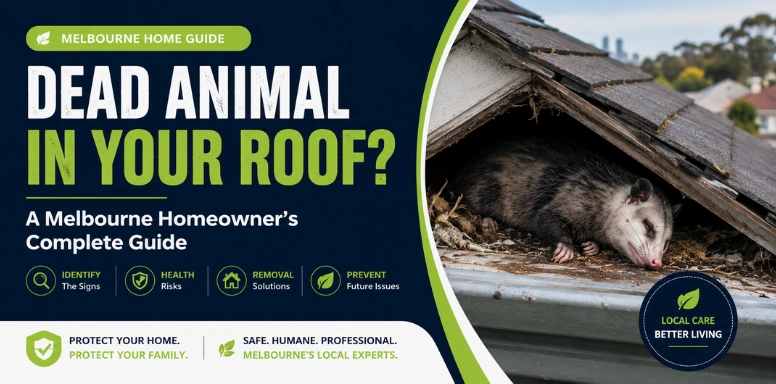
Dead Animal in Your Roof? A Melbourne Homeowner's Guide
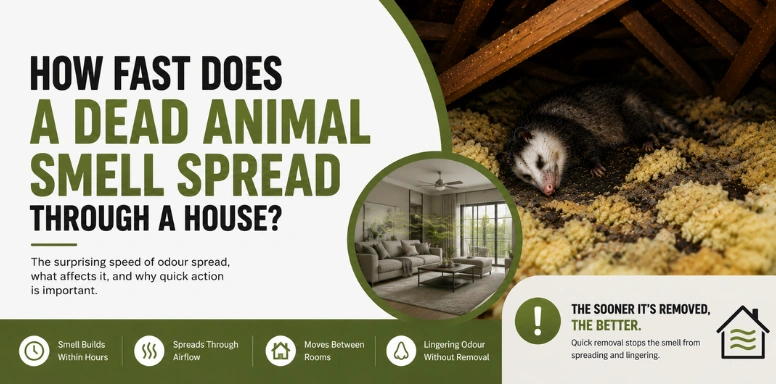
It usually starts the same way. There were scratching noises in the ceiling for a few nights, then they stopped. Two days later a smell appears in the hallway that you cannot place, and by the weekend it has taken over half the house. Somewhere above your ceiling an animal has died, and every hour it stays there the cleanup gets a little larger.
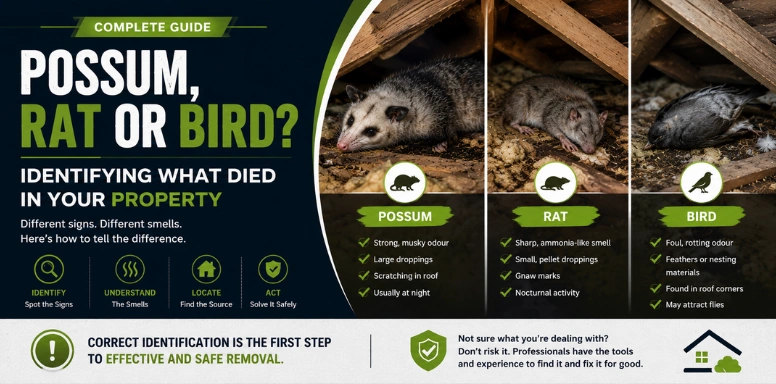
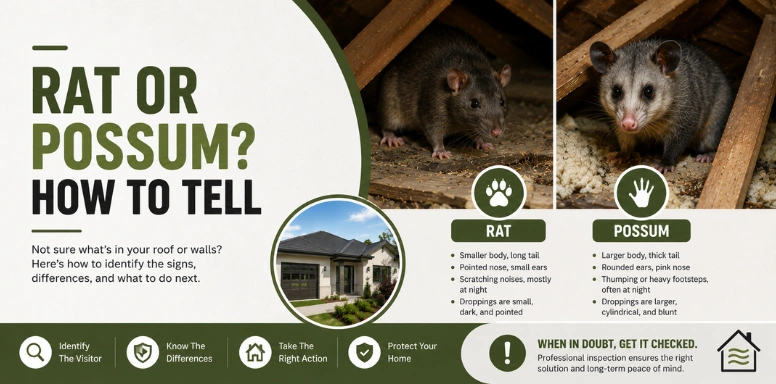
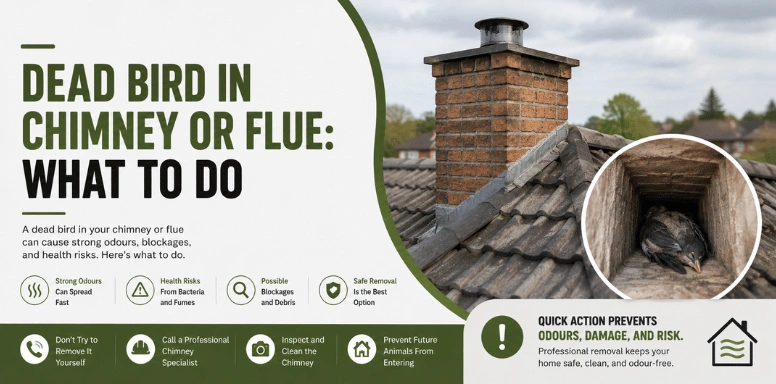
Roof cavities are the single most common place we find deceased animals in Melbourne homes. They are warm, dark, sheltered from weather, and easily reached through a broken tile, a gap at the fascia or a damaged eave vent. Rats, mice, possums and birds all use them. Most of the time they come and go without incident. The problem arrives when one of them dies up there, particularly after taking rodent bait elsewhere on the property.
This guide covers how to confirm what you are dealing with, why the Melbourne climate makes it worse, why going up there yourself is a bad idea, what a proper removal involves, and what drives the price.
How to Confirm It Is Actually a Dead Animal
Not every bad smell in a house is a carcass. Blocked drains, a failed sewer vent, damp under floorboards and mould in a wall cavity can all present similarly to an unfamiliar nose. There are, however, four patterns that point strongly at decomposition.
1. The Smell Has a Shape Over Time
Decomposition odour is not constant. It follows a curve:
- Days 1 to 3: little or nothing detectable, occasionally something faintly sweet.
- Days 3 to 7: a sharp build, usually the point at which it becomes impossible to ignore.
- Weeks 2 to 3: a plateau at full intensity.
- Week 4 onward: a slow decline as the remains dry out.
A smell that has sat at exactly the same intensity for a month is far more likely to be a plumbing or moisture fault than an animal.
2. Insects Turn Up Before You Smell Anything
A sudden appearance of large blowflies indoors, clustering at windows, downlights and skirting boards in an otherwise clean house, is one of the clearest indicators there is. Flies find a carcass long before people smell it, and they congregate at the warmest light source nearest the body. If you are seeing maggots on the floor beneath a ceiling, the animal is directly above that point.
3. Staining on the Plaster
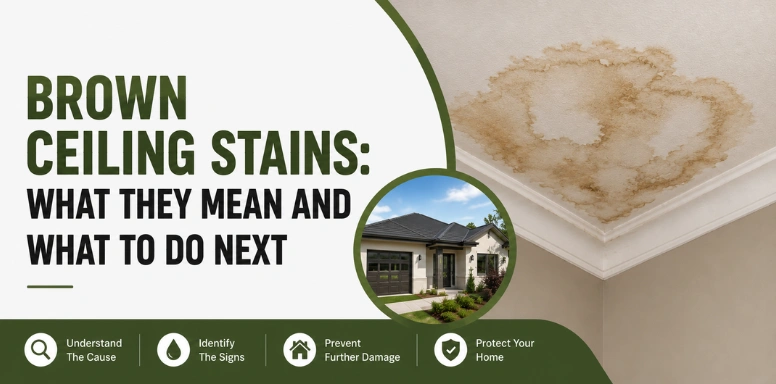
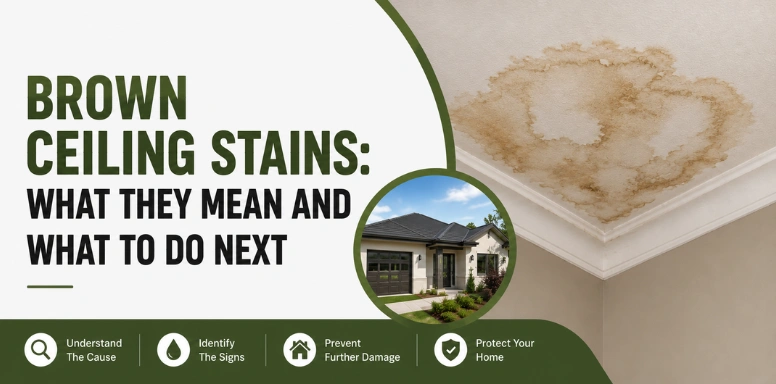
As a body decomposes it releases fluid, and that fluid travels downward through insulation onto the plasterboard. A spreading yellow brown patch on a ceiling with no plumbing above it, that keeps growing through dry weather, is almost always seepage from a carcass in the cavity directly overhead.
4. Your Pets Know First
Cats and dogs will fixate on a specific section of ceiling, wall or floor days before a person notices anything at all. If your dog has started sitting and staring at one spot in the hallway, that is worth investigating.
Why the Melbourne Climate Makes It Worse
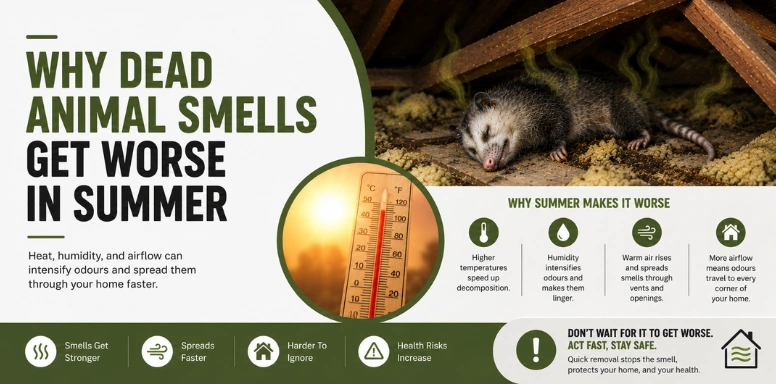
Roof cavities in Melbourne swing through enormous temperature ranges. On a hot February afternoon the space above your ceiling can sit thirty degrees above the outside air. That heat has three consequences:
- Decomposition accelerates. Bacterial activity roughly doubles for every ten degree rise, so a summer carcass moves through the whole process several times faster than a winter one.
- Odour is driven downward. Hot cavity air pushes vapour through every ceiling penetration, which is why so many households report the smell being close to unbearable in the late afternoon and noticeably milder by morning.
- Fluids travel further. Liquid that would otherwise stay localised gets pushed deeper into insulation batts and timber.
This is the practical reason we push people not to wait it out. A carcass dealt with on day two is a contained job. The same animal on day twenty has contaminated a much larger area of insulation and plaster.
Why You Should Not Go Up There Yourself
The instinct to grab a torch and go looking is understandable, and we would ask you to resist it. The pathogen exposure is real, but honestly it is not the main risk. The main risks in a residential roof cavity are structural and electrical.
- Ceilings do not hold an adult. Plasterboard will not take your weight. Stepping between joists puts you through the ceiling, and people are seriously injured doing exactly this every year.
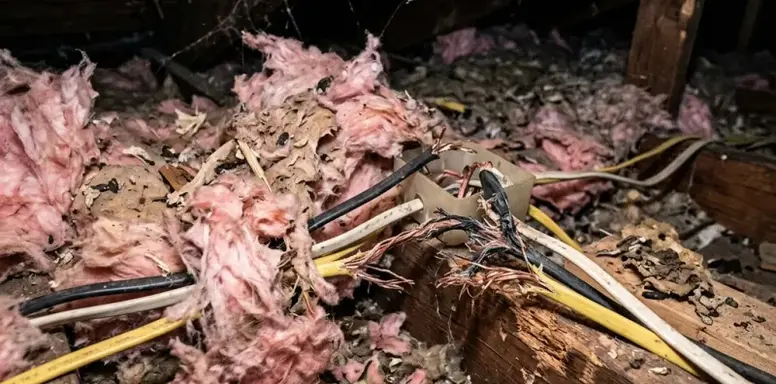
- Live wiring is everywhere. Often old, often unclipped, and frequently buried under loose fill insulation where you cannot see it.
- Heat and airborne dust. No ventilation, temperatures well above forty degrees in summer, and airborne particulate from disturbed insulation and droppings.
- Confined access. Animals die in the crawl spaces near the eaves, which is exactly where the cavity is tightest and hardest to exit from.
There is also a practical problem. Most people cannot find the animal. They crawl around in the heat for an hour, disturb the insulation, put a foot through the ceiling, and still leave without the carcass.
What Professional Removal Actually Involves
A proper job runs in five stages, and skipping any of them is what causes a smell to return weeks later.
- Detection. A technician works the odour gradient room by room, then uses detection equipment and a pilot hole check to confirm the exact position before touching anything. This determines whether access comes from the manhole or whether a small opening is required.
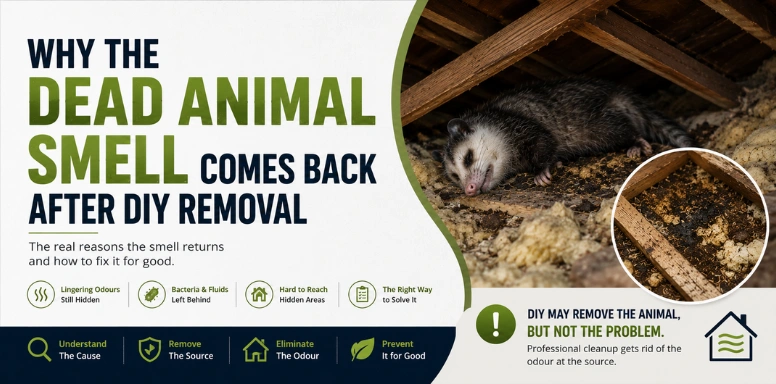
- Extraction. The carcass and all nesting material are removed into sealed biohazard containment. Nesting material matters more than people expect, because it holds both parasites and a large share of the odour.
- Contaminated material removal. Insulation that has absorbed fluid cannot be salvaged. It is porous and will hold bacteria and odour indefinitely. Affected batts or loose fill are bagged and removed, and the substrate beneath is treated.
- Decontamination and deodorising. Hospital grade antimicrobials first, then bio-enzymatic counteractants that break the decay compounds apart at a molecular level rather than masking them. Stubborn cases get air movers and hydroxyl treatment.
- Prevention. The technician should show you the broken tile, unscreened vent or eave gap responsible so it can be closed properly.
One caveat on that last step. Where possums are involved, sealing only happens once all remaining animals have left, because trapping a live protected native animal inside a sealed roof creates a far worse problem than the one you started with.
What It Costs and Why Nobody Quotes It Blind
Cost is driven by three things:
- The size of the animal, because body mass determines fluid volume and therefore how much material is contaminated.
- How accessible it is, since a bird just inside the manhole is a quick job and a possum in the far corner of a cathedral ceiling is not.
- How far contamination has spread, which is almost entirely a function of how long it has been there.
Any company quoting a firm fixed price before locating the animal is guessing, and that guess will be revised upward once they arrive. What you should expect instead is an honest indicative range on the phone based on what you describe, then a firm price on site once the technician has confirmed the location and the extent of the contamination, before any work starts.
You should also expect sanitisation to be included in that number rather than added later. Removal without decontamination is why so many people find the smell back a fortnight after a cheap job.
What to Do Right Now
- Turn off ducted heating and cooling so the system stops distributing odour into unaffected rooms.
- Ventilate the rooms you are using, and close the doors of rooms you are not.
- Photograph any ceiling stain with something for scale, and note the date.
- Do not paint over a stain and do not mask the smell with sprays or oils, since both make the source harder to trace.
- Note when the smell started, which room it appeared in first, whether it worsens in the afternoon, and what you heard in the ceiling beforehand.
If you are dealing with an odour you cannot place and any of the signs above sound familiar, call a removal technician and describe what you are experiencing. Most of the time a technician can tell you the likely species and rough location over the phone, before anyone sets foot in your roof.