Why Dead Animal Smells Get Worse in Summer
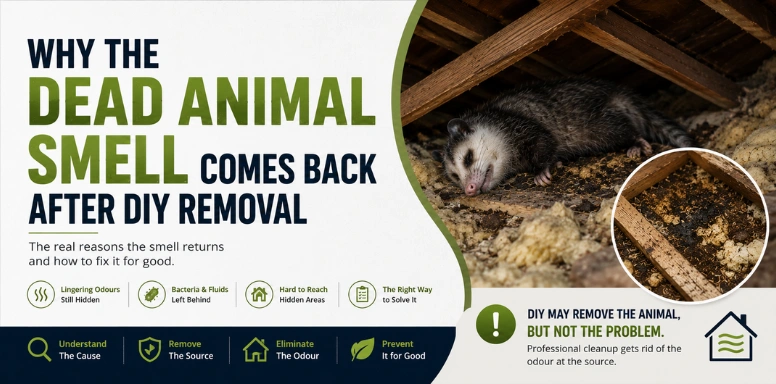
Every year it happens the same way. Through winter the phone rings steadily, a few calls a day, mostly people who have noticed something faint in a back bedroom. Then the first run of thirty degree days arrives and the volume triples overnight. The animals have not suddenly started dying in greater numbers. What has changed is the temperature inside the cavities they die in, and that single variable governs almost everything about how a dead animal problem behaves.
Decomposition Is a Chemical Reaction, and Heat Drives It
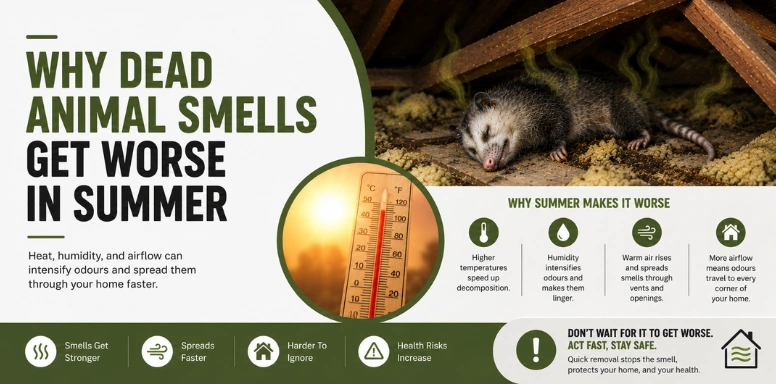
Everything that produces the smell is bacterial activity breaking down soft tissue. Like most biological chemistry, that activity roughly doubles in rate for every ten degree rise in temperature. A carcass in a fifteen degree subfloor and the same carcass in a forty five degree roof space are not on the same timeline at all. The second one is moving through the same process somewhere between four and eight times faster.
That is why the odour curve looks so different by season:
- Winter: a dead rat in a wall produces a mild, sour smell that builds slowly over a week, peaks gently, and fades across a month.
- Summer: the same rat can go from undetectable to unbearable in about forty eight hours. Households often tell us there was nothing at all on the Friday and by Sunday afternoon they could not use the upstairs.
How Hot a Melbourne Roof Actually Gets
People underestimate this badly. On a thirty five degree Melbourne day:
- Tiled roof cavity with poor ventilation: commonly fifty to sixty degrees, with the underside of dark tiles hotter again.
- Colorbond roof: hotter still through the early afternoon, though it sheds heat faster in the evening.
- Western wall cavities: similar behaviour in brick veneer construction, where the outer skin absorbs afternoon sun and radiates it inward.
- Subfloor: the exception. It stays comparatively cool and stable, which is why an animal under the house in summer often produces a slower, more drawn out odour than one in the ceiling directly above.
A roof cavity also holds most of its heat well into the evening, so the reaction does not stop when the sun goes down.
The Stages Compress, and So Does Your Decision Window
Decomposition moves through four recognisable phases:
- Fresh. Little detectable smell while bacterial activity builds.
- Bloat. Gases accumulate and the first strong odour appears.
- Active decay. The odour peaks and fluids are released into whatever is beneath. This is the phase that causes the damage.
- Dry down. A long tail during which the remains desiccate and the smell slowly declines.
In cool conditions those phases spread across four to six weeks. In summer heat the whole sequence can compress into eight to twelve days.
The practical consequence is that the window in which the job stays small closes much faster. In winter you might have a fortnight before fluids begin soaking into plaster and insulation. In a January roof you may have three or four days. This is the single biggest reason we push same day attendance harder in summer than at any other time of year, and why waiting to see whether it clears up by itself is a more expensive gamble than most people realise.
Why the Smell Travels Further When It Is Hot
Three things move odour through a house, and summer amplifies all of them.
Convection and Stack Effect
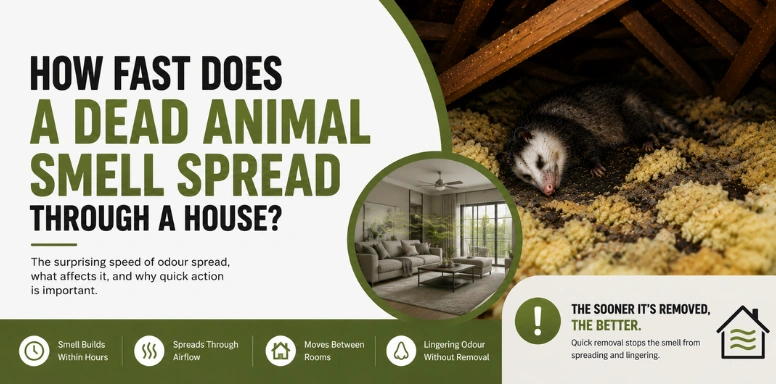
Warm air rises, so a heated roof cavity pushes air downward through every ceiling penetration as cooler air is drawn in elsewhere. Downlights, exhaust fans, cornice gaps and manhole surrounds all become delivery points. A cavity that was fairly sealed in winter behaves like a chimney in summer.
Your Cooling System
- Evaporative units draw large volumes of outside air through the roof space and push it into the living areas, which is the fastest way to distribute a roof odour through an entire house.
- Refrigerated ducted systems circulate air past duct runs that pass directly through the affected cavity.
Many summer callouts begin with the sentence, it only smells when the air conditioning is on, and that is a genuinely useful clue about where the animal is.
Increased Volatility
Cadaverine, putrescine and the sulphur compounds that dominate the smell evaporate more readily when warm, so more of the odour becomes airborne rather than staying bound to surfaces.
Flies and Parasites Arrive Faster
Blowflies locate a carcass by scent and can find one within hours in warm weather. Eggs laid on a summer afternoon can hatch inside a day. That means the secondary problem, larvae appearing at downlights and skirting boards, arrives far sooner than most people expect and is often the thing that finally prompts the call.
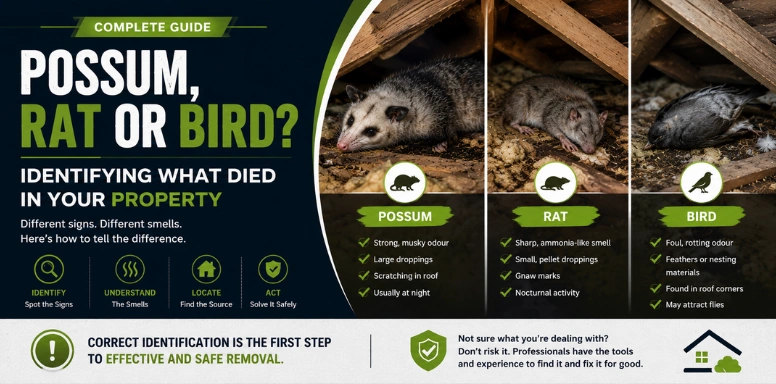
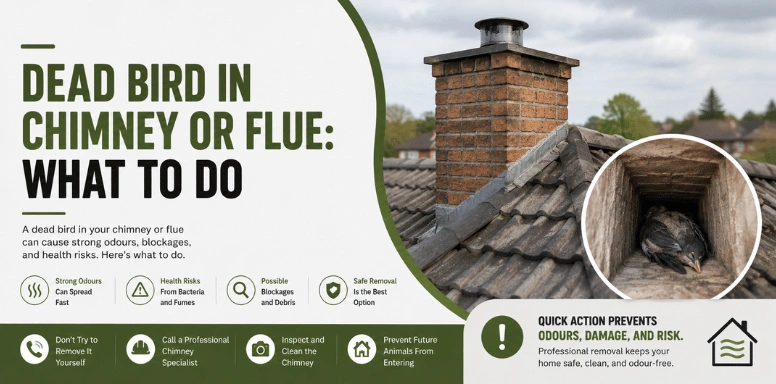
Mites and fleas move faster too. They leave a cooling body looking for a new warm host, and in summer that migration happens over days rather than a week or more. If a bird has died in a roof or wall, unexplained bites appearing in the room below is frequently the first sign anyone registers.
What Changes About the Job Itself
- Scope. Summer jobs are usually larger than winter jobs at the same point in the timeline, because more has already happened. There is more fluid, it has travelled further, and insulation is more likely to need cutting out and replacing rather than treating in place.
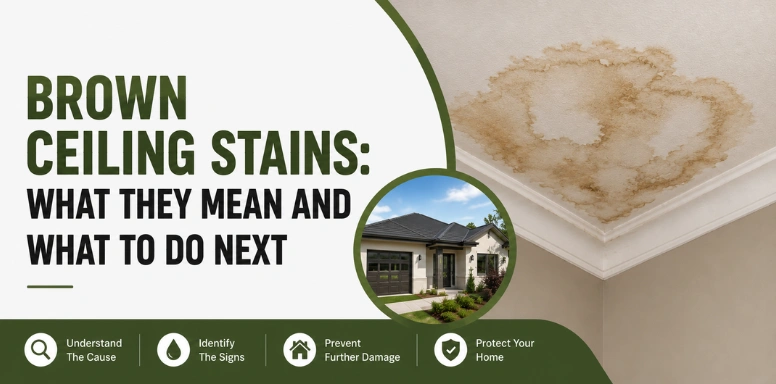
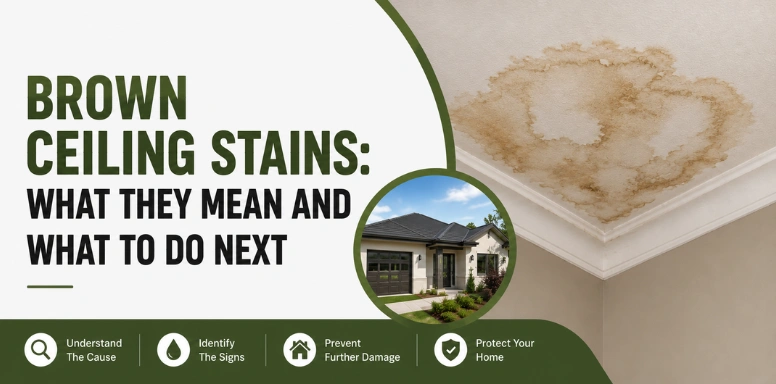
- Ceiling damage. Staining is more common, because saturated batts release moisture into the plaster more readily when warm.
- Detection. Detection equipment depends on temperature differences, and in a fifty degree roof cavity the contrast between decomposition moisture and surrounding material narrows. Early morning inspections are noticeably more productive in summer, which is why we will sometimes suggest a first thing appointment rather than a midday one.
- Access safety. Roof cavities at those temperatures are genuinely dangerous to work in for extended periods, so summer recoveries are planned around shorter working intervals and earlier starts.
What You Can Do Before the Heat Arrives
The best summer preparation happens in autumn and winter, when the work is easier and there is nothing urgent driving it.
- Replace broken or slipped roof tiles.
- Close gaps at the fascia and barge boards.
- Screen eave vents and weep holes with appropriate mesh.
- Repair torn subfloor screens and damaged air bricks.
- Cut back tree branches that give possums a bridge onto the roof line.
- Time your baiting. If rodent baits are laid in late spring, poisoned animals will die inside wall and roof cavities through the hottest months, which is close to the worst possible combination. Baiting in autumn produces the same number of carcasses in far more forgiving conditions.
If You Can Smell Something Now
Do not wait it out. In summer the difference between calling on day two and calling on day nine is frequently the difference between one small access hole and a section of replaced insulation with a repainted ceiling. Turn the ducted system off, ventilate the rooms you are using, and note where the smell is strongest, when it started and whether it worsens in the afternoon. A technician can usually name the likely species and cavity from that description before arriving.
If the smell in your home is getting stronger by the day, book a same-day inspection and have it dealt with while it is still a contained job.