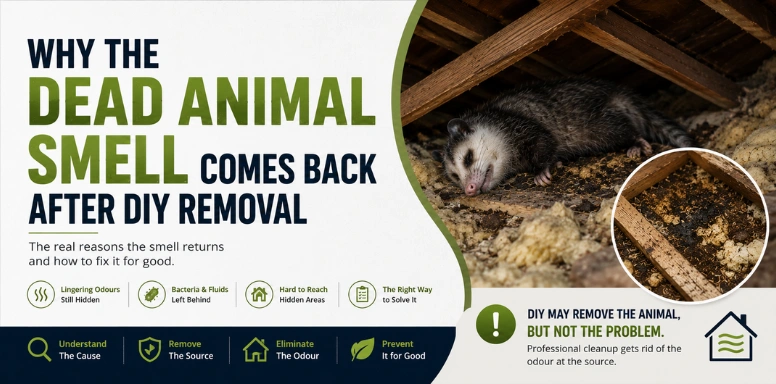
Why the Dead Animal Smell Comes Back After DIY Removal
This is one of the most common calls we take. Someone located a dead rat under their floorboards, removed it themselves, aired the house out, and felt genuinely relieved. For about ten days everything was fine. Then the first warm afternoon arrived and the smell came back almost as strongly as before.
Nothing went wrong with the removal. The problem is that by the time you can smell a decomposing animal, the carcass itself has stopped being the only source of the odour. Understanding why requires a short detour into what that smell actually is.
What You Are Actually Smelling
Decomposition odour is not one smell. It is a cocktail of volatile organic compounds produced as bacteria break down soft tissue. The main players are:
- Putrescine and cadaverine — responsible for the distinctive sweet, heavy, rotting character most people describe.
- Hydrogen sulfide — the sharp rotten egg note.
- Methanethiol and dimethyl disulfide — sulphur compounds that carry a long way through cavities.
- Organic acids — the sour edge that lingers in fabric.
Two properties of these molecules matter enormously. They are volatile, meaning they evaporate readily and travel through air. And they are small and readily absorbed, meaning they penetrate deep into porous materials rather than sitting on the surface where you could wipe them off.
Human noses are also extraordinarily sensitive to them, which makes evolutionary sense. We can detect some of these compounds at concentrations of a few parts per billion. This is why a single mouse behind a wall can make an entire room unusable, and why a trace of residual contamination is still very noticeable long after the source is gone.
The Real Source: Everything Around the Carcass
Decomposition is a wet process. A body releases a significant volume of fluid, and that fluid does not stay put. It runs downhill, soaks into whatever is beneath and beside it, and carries bacteria and odour compounds with it.
Where the Contamination Ends Up
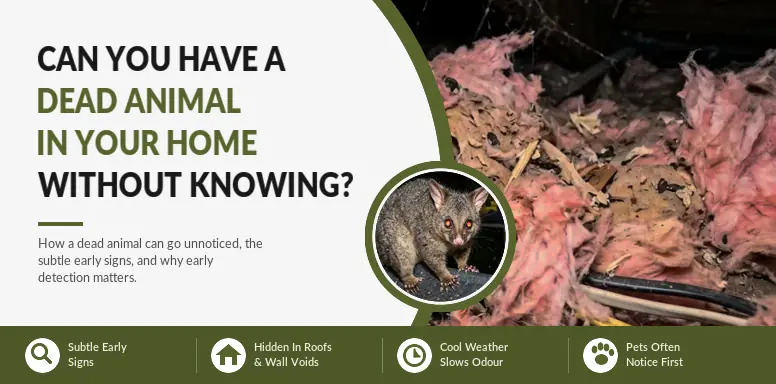
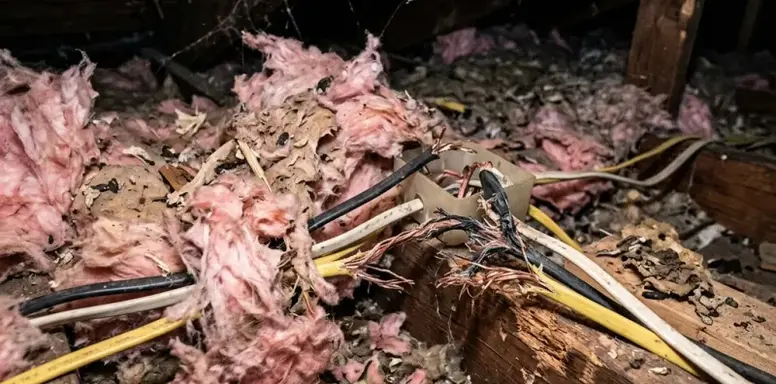
- Roof cavity: insulation. Batts and loose fill are designed to trap air in a porous matrix, which makes them close to perfect at trapping and holding odour molecules. Contaminated insulation keeps releasing smell for months and cannot realistically be cleaned in place.
- Wall cavity: the bottom plate, the studs and the back face of the plasterboard. Untreated pine absorbs readily and holds odour deep in the grain.
- Subfloor: soil and joists. Soil in particular acts as an enormous reservoir and is the hardest of the three to treat.
- Nearby rooms: carpet, underlay, curtains, upholstery and clothing in a wardrobe absorb odour from the air over days and weeks, then release it back slowly.
So when you remove the carcass and the smell returns, what you are smelling is the contaminated material the carcass left behind. Removing the body addressed maybe half the problem.
Why Warm Weather Brings It Back
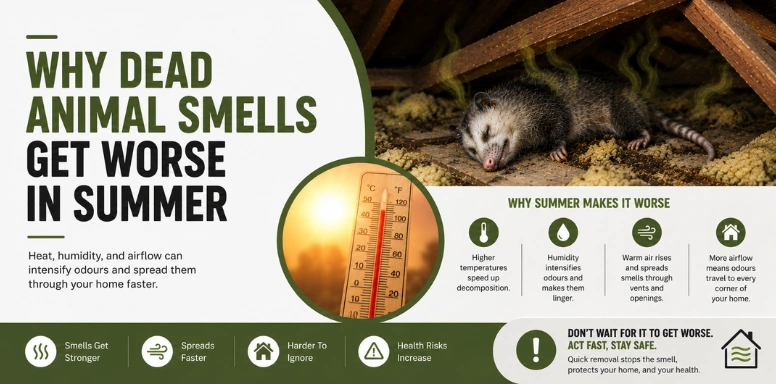
The reason the smell so often reappears on the first warm day is straightforward physics. Volatility increases with temperature. Odour compounds locked into cool timber, plaster and insulation stay relatively inert through cold weather, then release far more readily once the material warms.
This creates a frustrating cycle. A DIY removal in June seems entirely successful. Come the first hot week in October, the residual contamination in the insulation starts outgassing again and the household concludes a second animal has died. Usually it has not. It is the same contamination, simply warmer.
Why Air Fresheners, Bleach and Ozone Do Not Fix It
Masking Agents
Sprays, plug-ins and scented candles do not remove anything. They add a second set of aromatic molecules alongside the first. Your nose does not average the two, it detects both, and the resulting combination of floral perfume and decomposition is frequently worse than the original. It also fades within hours while the underlying source keeps producing.
Bleach
Sodium hypochlorite is a strong disinfectant on a hard, non-porous, pre-cleaned surface. It falls short here for three reasons:
- It does not penetrate porous material, so absorbed odour is untouched.
- It deactivates rapidly on contact with organic matter, which is precisely what it is meant to be treating.
- It is corrosive to metal fixings and can damage the timber and plaster you are trying to save.
Ozone Generators
Ozone sits in a middle category. It genuinely does oxidise odour compounds, but it is a respiratory irritant that requires an unoccupied, sealed space and a proper airing period afterwards, and it degrades rubber and some plastics with repeated use. It is a legitimate professional tool used carefully, not a device to run in an occupied family home.
What Actually Eliminates It
Proper odour elimination runs in a set sequence, and skipping steps is what causes recurrence.
- Remove the source entirely, including nesting material and any fluid saturated debris around it.
- Remove what cannot be salvaged. Contaminated insulation is the main one. It is far cheaper to replace a few batts than to spend six months chasing a smell that will never fully clear.
- Clean and decontaminate the substrate. Physical cleaning of the affected timber and plaster, then a hospital grade antimicrobial to deal with the bacterial load.
- Apply bio-enzymatic counteractants. This is the step that matters most and the one almost always missed in DIY attempts. These products contain enzymes that break the chemical bonds of the decay compounds themselves, destroying the molecule rather than covering it. They need contact time and they need to be applied to every affected surface, not sprayed into the air.
- Move air aggressively. High volume air movers pull residual vapour out of the cavity instead of letting it seep into living areas. For persistent cases, hydroxyl generators can run safely in occupied spaces and continue neutralising airborne compounds over a day or two.
How Long Should It Take
After a properly executed treatment, here is a realistic expectation:
- Immediately: a substantial and obvious improvement.
- 24 to 72 hours: near total resolution as the enzymatic treatment finishes working and residual vapour clears.
- First warm day afterwards: a faint trace is not unusual, and it should keep fading rather than building.
What should not happen is the smell returning at full strength weeks later. If it does, contaminated material was left behind, and it needs to be found rather than treated again.
If You Have Already Done the Removal Yourself
You do not need another removal. You need decontamination of what was left behind, which is a different job with a different scope. Before you call, it helps to have three things ready:
- Where exactly you found the animal, and what was directly underneath it.
- Whether you removed any insulation or soaked material at the time, or only the carcass.
- Which rooms still smell, and whether the smell tracks with the weather or with the heating and cooling running.
That is enough for a technician to work out how much material is still holding odour and to give you a realistic scope. It is a specific job worth having done properly once rather than repeatedly guessing at it through another summer.