How Much Does Dead Animal Removal Cost in Melbourne?
It is the first question almost everyone asks, and it is a fair one. The honest answer is that dead animal removal in Melbourne is not a fixed price service, and any company that quotes you a firm figure over the phone before knowing where the animal is has either guessed high to protect themselves or guessed low and will revise it on arrival. This article explains what actually drives the number, so you can judge whether a quote you have been given is reasonable.
Why Nobody Can Quote It Blind
Two callouts described identically on the phone can be entirely different jobs. A rat in a roof cavity reachable from a manhole might take ninety minutes. A rat in a stud bay behind a tiled bathroom wall, dead for three weeks, might take four hours plus reinstatement. Both start as, there is a smell and I think it is a rat.
What a good operator will give you is a two stage answer:
- An indicative range on the phone, based on the species, the likely cavity and how long it has been there.
- A firm price on site, once the animal is located and the contamination assessed, and always before any work begins.
What you should be wary of is a fixed price quoted sight unseen, or a very low number that gets you onto the schedule and then grows once the technician is in your roof.
The Six Factors That Actually Move the Price
1. Size of the Animal
This is the biggest single driver. Body mass determines fluid volume, which determines how much material is contaminated. A mouse is a small job. A rat is several times that. A possum, at three to five kilograms, produces roughly ten times the fluid of a rat and frequently means insulation replacement. A dog is larger again and usually needs two technicians.
2. Where It Is and How You Reach It
An animal just inside a roof manhole is quick. These are the situations that cost more:
- A subfloor crawl space with four hundred millimetres of clearance.
- Behind a cathedral or raked ceiling with no cavity access.
- Inside a duct run or a disused flue.
- In a wall behind tiling, cabinetry or a stone benchtop.
Access is often a larger part of the cost than the removal itself.
3. How Long It Has Been There
A carcass found on day two is a contained recovery. The same animal on day twenty has released its fluids into insulation, plasterboard, framing or soil, and the decontamination becomes the bulk of the work. This is why waiting is usually a false economy rather than a saving.
4. How Much Material Needs Replacing
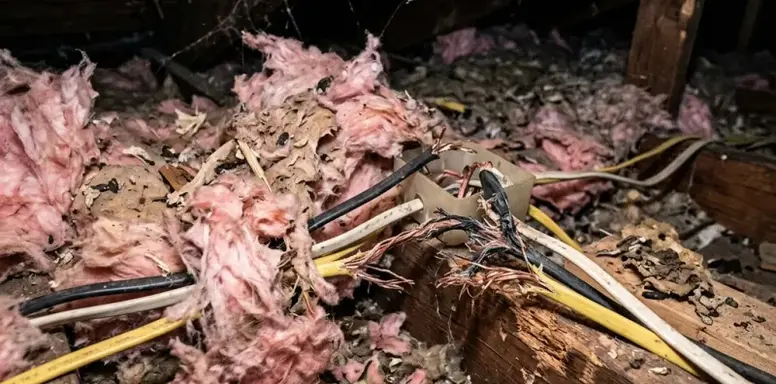
Treating a surface is cheap. Cutting out and replacing saturated ceiling insulation across several square metres is not, and neither is removing contaminated soil from beneath a subfloor. This line item is where possum jobs in particular become expensive.
5. Reinstatement
If a wall or ceiling has to be opened, someone has to close it again properly. A neat access panel cut and patched in gyprock is real work. Lifting and relaying roof tiles is less so. Ask whether making good is included in the figure you are quoted, because it is not always.
6. Timing
Business hours are the usual rate. Genuine after hours, weekend and public holiday attendance carries a callout loading. That is reasonable, but it should be disclosed on the phone rather than appearing on the invoice.
What Should Be Included and What to Question
A full job includes all six of the following:
- Locating the animal, using detection equipment rather than guesswork.
- Removing it along with any nesting material.
- Disposing of it correctly, in sealed containment through approved channels.
- Decontaminating every affected surface.
- Deodorising the cavity with enzyme based products.
- Telling you where the animal got in.
If a quote covers only the removal, it is not a full job and the smell will very likely return. The most common way a cheap quote becomes an expensive one is sanitisation billed separately. Removal without decontamination leaves saturated insulation and bacterial residue in place, the odour comes back within a fortnight, and the second visit costs more than doing it properly the first time.
When comparing quotes, the question to ask is not what does it cost. It is what is in that number.
Rough Expectations by Species
These are relative, not fixed prices, and they assume reasonable access and a reasonably fresh carcass.
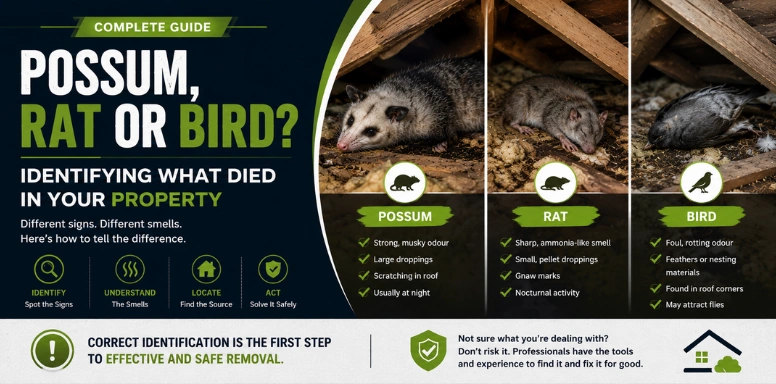
- Mice and small rodents: the lower end. The caveat is that mice die in numbers along shared runs, so a job that looks like one animal often turns out to be three or four in different cavities.
- Rats: noticeably higher, mainly because of location. Rats die in wall voids and subfloors rather than open roof space, so detection and access work carries most of the cost.
- Birds: highly variable. One in an accessible roof space is at the low end. One wedged in a flue, inside a duct run or behind solar panels is at the high end, and bird jobs carry the additional cost of mite treatment.
- Possums: typically the most expensive residential callout, because body mass means insulation replacement and often ceiling remediation on top of the recovery itself.
- Pets: priced differently again, since the recovery is usually simple and the variable is aftercare. Cremation, whether communal or individual with ashes returned, should be itemised separately from the collection so you can see exactly what each part costs.
Does Home Cover Pay For Any of It
Sometimes, and it depends on your policy. Insurers generally treat sudden damage differently from gradual deterioration, so a possum that died last week and stained a ceiling may be viewed differently to a rodent problem that has been developing for months. Some policies exclude vermin damage entirely.
What helps a claim is documentation. Ask for the following as part of the job rather than trying to reconstruct it afterwards:
- Photographs of the carcass in position before removal.
- Photographs of the contaminated insulation and any ceiling damage.
- A written report describing the species, the location and the extent of contamination.
- An itemised invoice separating removal, decontamination and any reinstatement.
Five Ways to Keep the Cost Down
- Call early. This is the only advice that reliably saves real money. Every day of delay increases the amount of contaminated material.
- Describe it accurately. Where the smell is strongest, when it started, whether there were noises beforehand, whether it worsens in the heat, and whether there is a stain. That detail lets a technician bring the right equipment and quote closer to reality.
- Book in hours if it is safe to. If the smell is unpleasant but not making the house unusable, a next morning appointment avoids the after hours loading.
- Clear access before arrival. Moving boxes away from the manhole or clearing the subfloor hatch is fifteen minutes of your time that would otherwise be billed at a trade rate.
- Deal with entry points afterwards. The cheapest dead animal removal is the one you do not need next season, and closing the gap that let the animal in is usually a small job compared with the recovery.
Getting a Number You Can Trust
Ask for an indicative range on the phone, a firm price on site before work starts, and clarity about what is included. A reasonable operator will give you all three without hesitation, and will tell you honestly if the smell you are describing sounds more like a drainage fault than an animal.
If you would like a realistic figure for your situation, Get an Accurate Quote and describe what you are dealing with. There is no charge for the conversation and no obligation to book.